gdt::runoutFunction in std::gdt
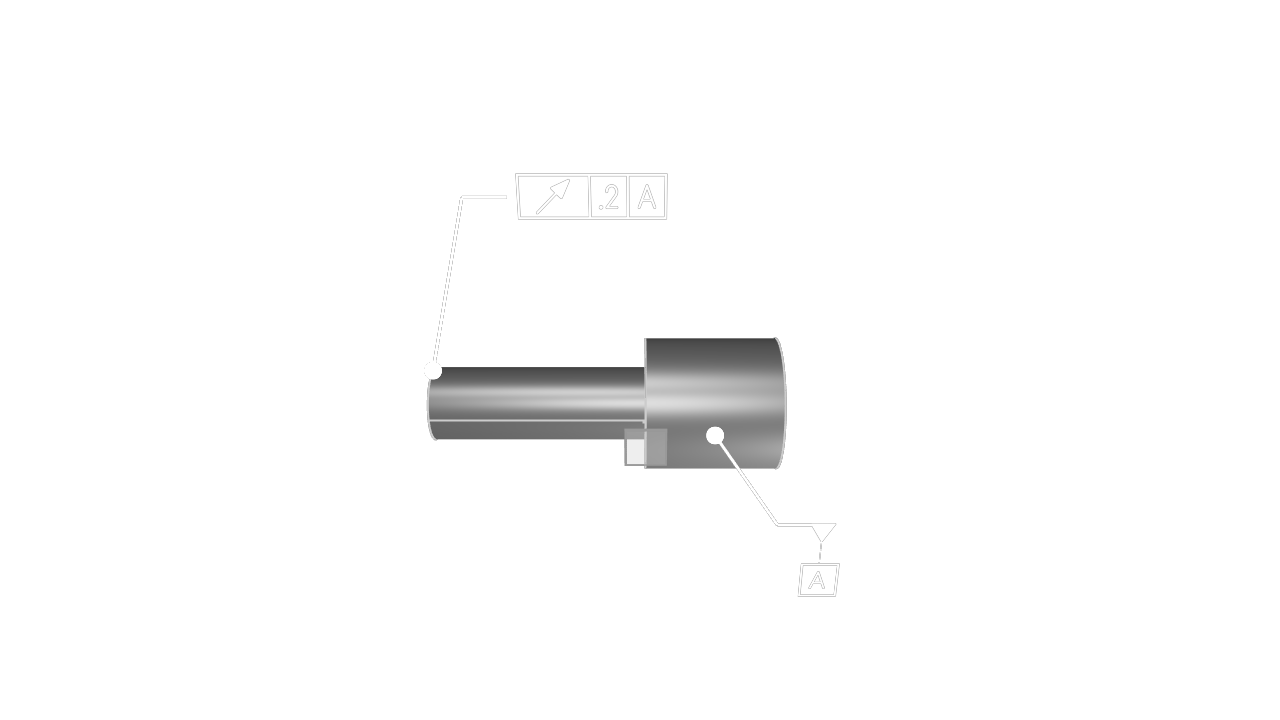
GD&T annotation specifying circular runout relative to a datum axis.
This is part of model-based definition (MBD).
Runout controls how much a round feature may vary as it rotates around a referenced datum axis. It may be applied to circular edges or round faces, such as the wall of a cylinder. Datum references are required.
Runout is applied regardless of feature size and does not use MMC or LMC.
Arguments
| Name | Type | Description | Required |
|---|---|---|---|
tolerance | number(Length) | The circular runout relative to the datum axis that is acceptable. | Yes |
datums | [string; 1+] | The datum references to display in the feature control frame. Supports up to primary, secondary, and tertiary datums. | Yes |
faces | [TaggedFace; 1+] | The faces to be annotated. | No |
edges | [Edge or any; 1+] | The edges to be annotated. Edge specifier objects ({ sideFaces = [...], endFaces? = [...], index? = 0 }) are experimental; do not use them in generated or user-facing KCL yet. | No |
precision | number(_) | The number of decimal places to display. The default is 3. Must be greater than or equal to 0 and less than or equal to 9. | No |
framePosition | Point2d | The position of the feature control frame relative to the leader arrow. The default is [100mm, 100mm]. | No |
framePlane | Plane | The plane in which to display the feature control frame. The default is XY. Other standard planes like XZ and YZ can also be used. The frame may be displayed in a plane parallel to the given plane. | No |
leaderScale | number(_) | Visual scale of the leader dot. The default is 1.0, which maps to the calibrated normal dot size. The value is normalized against fontSize so the dot stays consistent as text size changes. Must be greater than 0. | No |
fontSize | number(Length) | The model-space height to use for annotation text. The default is 10mm. Explicit units are supported; bare numbers use the file's default length unit. This changes the scene size, not the internal raster texture quality. | No |
annotationName | string | Human-friendly name for this annotation in exports and model metadata. This is not displayed visually. | No |
Returns
[GdtAnnotation; 1+]
Examples